3 min read
Oct 23, 2026
How underground soft rock mining works with layered deposits
- Career development,Company,Williams F1 partnership,Discover Komatsu
3 min read

Potash helps grow food. Salt supports food processing and road safety. Gypsum goes into building materials, while trona is refined into soda ash for glass and other products. Some of these materials are mined underground, where specialized equipment and connected systems work together to follow the deposit and move material to the surface.
Many of the essential products powering modern society and high-performance engineering trace their origin to underground soft rock mining.
Potash feeds global fertilizer production, helping agriculture keep pace with food demands. Rock salt drives chemical manufacturing, food processing, pharmaceuticals and winter road safety. Trona is refined into soda ash, a vital ingredient in glass, eco-friendly detergents and industrial processes. Gypsum forms the backbone of modern building materials, including drywall and cement. And coal is used to generate electricity.
These materials may seem very different from one another, but they share something important: they begin as geological deposits that have to be found, accessed and recovered.
Mining is one step in that larger journey from the ground to the products people use. And mining does not happen in just one way. The location, shape, thickness and surrounding geology of a deposit help determine whether it is more practical to mine from the surface, through underground hard rock methods or through other underground approaches.
For some layered deposits, that leads to a very different kind of mine: underground soft rock mining.
A mineral deposit can lie near the surface, deep underground or within a relatively continuous layer. Its shape, thickness, geology and surrounding conditions help determine how it can be accessed and what kind of equipment will be needed.

Underground soft rock mining is commonly associated with deposits such as potash, salt, gypsum and coal, along with other relatively continuous industrial-mineral deposits. For these stratified, lower-strength sedimentary deposits, the primary types of underground soft rock mining methods are room and pillar mining and longwall mining.
The method still depends on the deposit. Room-and-pillar, longwall and other mining approaches are selected according to geology, seam characteristics, mine design and operating requirements. The equipment and the process are designed around the material being mined and the way that deposit can be accessed.
For flexible, smaller-scale or irregular deposits, room and pillar mining is used. It’s often used first to dig main tunnels and prepare an area before setting up a larger longwall system. It is an underground mining technique in which the material is extracted across a horizontal plane, creating a grid of open "rooms" while leaving untouched columns or "pillars" of rock or mineral to support the roof, the “overburden.”
For massive, uniform, continuous mineral seams, for maximum speed, efficiency and continuous cutting, longwall mining is used. Longwall mining is a highly productive underground mining method where a large rectangular block of coal or mineral, known as a panel, is extracted in a single continuous operation along a wide face. The roof is allowed to cave in safely behind the active cutting machine.
The machines can look imposing, but their purpose is straightforward with each performing specific parts of the extraction process while fitting into a tightly coordinated underground system. Specialized heavy machinery is utilized to cut, load and haul materials without the need for traditional drilling and blasting.
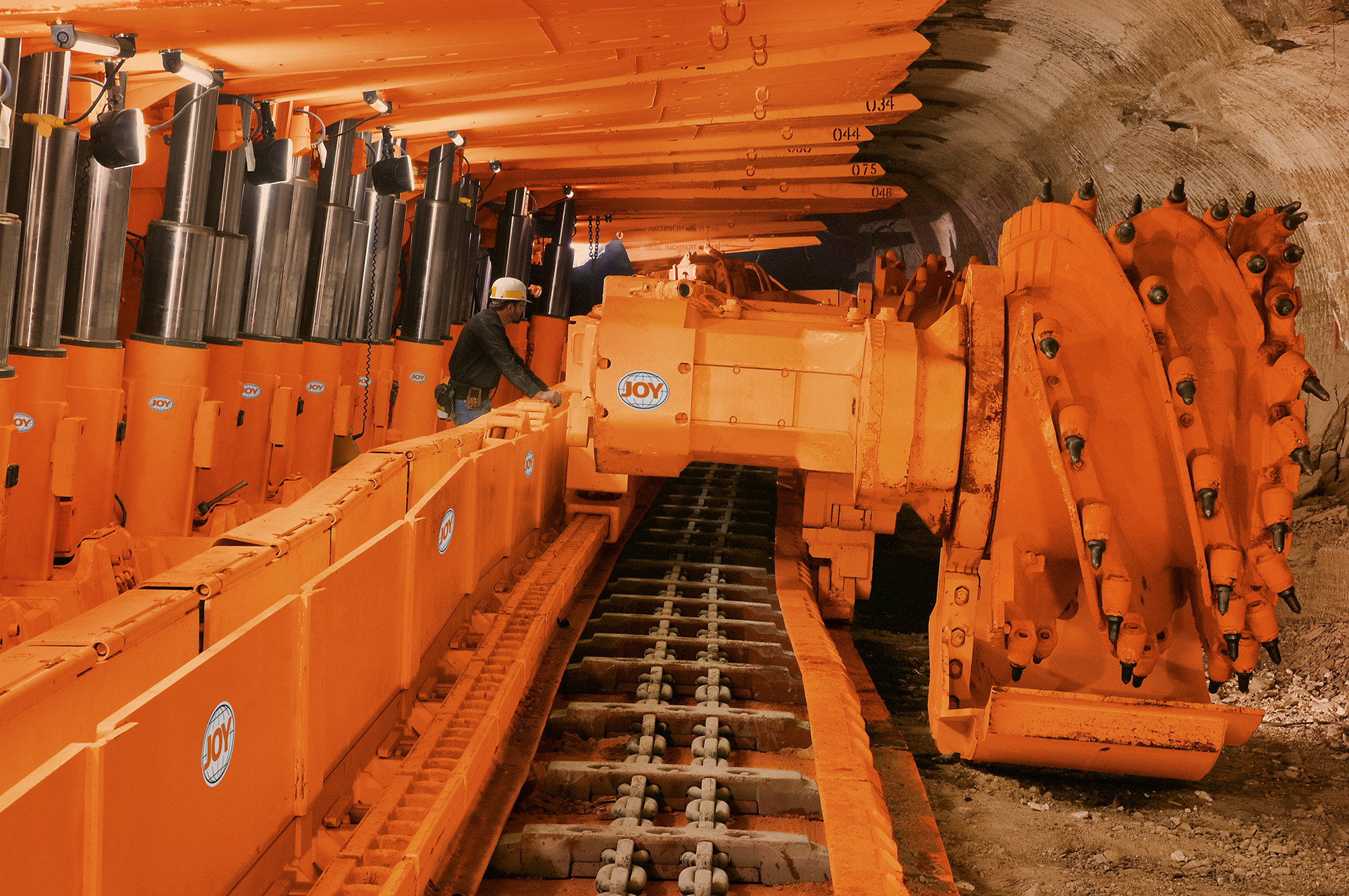
When extraction is continuous, material handling becomes part of the production process itself. Material leaving the cutting machine needs somewhere to go immediately, and every transfer point becomes part of the larger system.
For mineral extraction, continuous miners or longwall shearers scrape through the mineral seam and move the soft rock or mineral onto an integrated conveyor or armored face conveyor (AFC).
The material is hauled and transported away from the face by shuttle cars, battery haulers or AFCs. The AFC consists of heavy-duty chain conveyors that sit below the longwall shearers to move the extracted rock. Shuttle cars and battery haulers are low-profile vehicles that take the material to a primary conveyor.
After materials are collected, they are distributed to the mine’s main conveyor system they are brought to the surface to be crushed, washed, graded and loaded onto trucks or trains for final shipment.
Cutting, loading, haulage and conveying form a connected path through the mine. A shuttle car is a low-profile rubber-tired vehicles that receives material from a continuous miner and transports it to a primary conveyor.

An underground mine can stretch across a network of roadways, production areas and transport routes, making communication and visibility as important as physical access. Teams need to understand where equipment is working, what machines are doing and where a developing issue may affect production.
Connected systems can bring together information such as equipment location, machine data, production activity and equipment condition. That information can help a dispatcher understand where work is happening, help maintenance teams investigate developing issues or help supervisors coordinate changing priorities.
Automation and remote operation can support selected tasks in some applications, while other technologies can help people monitor equipment and operating conditions from a central location. The point is not to collect information simply for its own sake. It is to make useful information available to the people responsible for deciding what happens next.
The people running the mine remain essential. Operators, maintenance teams, engineers, supervisors and dispatchers combine technology with experience to keep the operation moving.
Connected mine systems can bring equipment, location and operational information together, helping teams understand what is happening across the mine and coordinate decisions as production and operating conditions change.

A modern underground soft rock mine is a carefully coordinated system. The cutting machine, haulage equipment, conveyors, power, ventilation, ground support and digital systems all have to work within the same physical environment. A change in one part can affect another: a different cutting sequence can change material flow, a maintenance issue can alter haulage, and a new technology can require changes to how people work.
That is where experience matters. Understanding the equipment is only part of the job. Mine teams and their technology and equipment partners also need to understand the application, the constraints of the deposit and how decisions in one area affect the wider operation.
Komatsu brings together equipment, technology, solutions and service capabilities, including the long history of the Joy brand in underground mining. The value is not simply having the individual pieces. It is understanding how they can work together around the needs of a particular operation.
A bag of fertilizer, a sheet of drywall or a load of road salt, finished products we see everyday may seem far removed from mining, but each began with a deposit in the ground and a decision about how that material could be reached.
For underground soft rock mining, that decision can lead to an extensive network of cutting machines, haulage systems, conveyors, infrastructure and technology operating below the surface. Understanding the hidden process is one way to see how much goes into the materials we use everyday.
See how mining teams across surface and underground operations combine skilled people, equipment, technology, service and support, and how Komatsu works alongside customers to help address complex operational challenges.
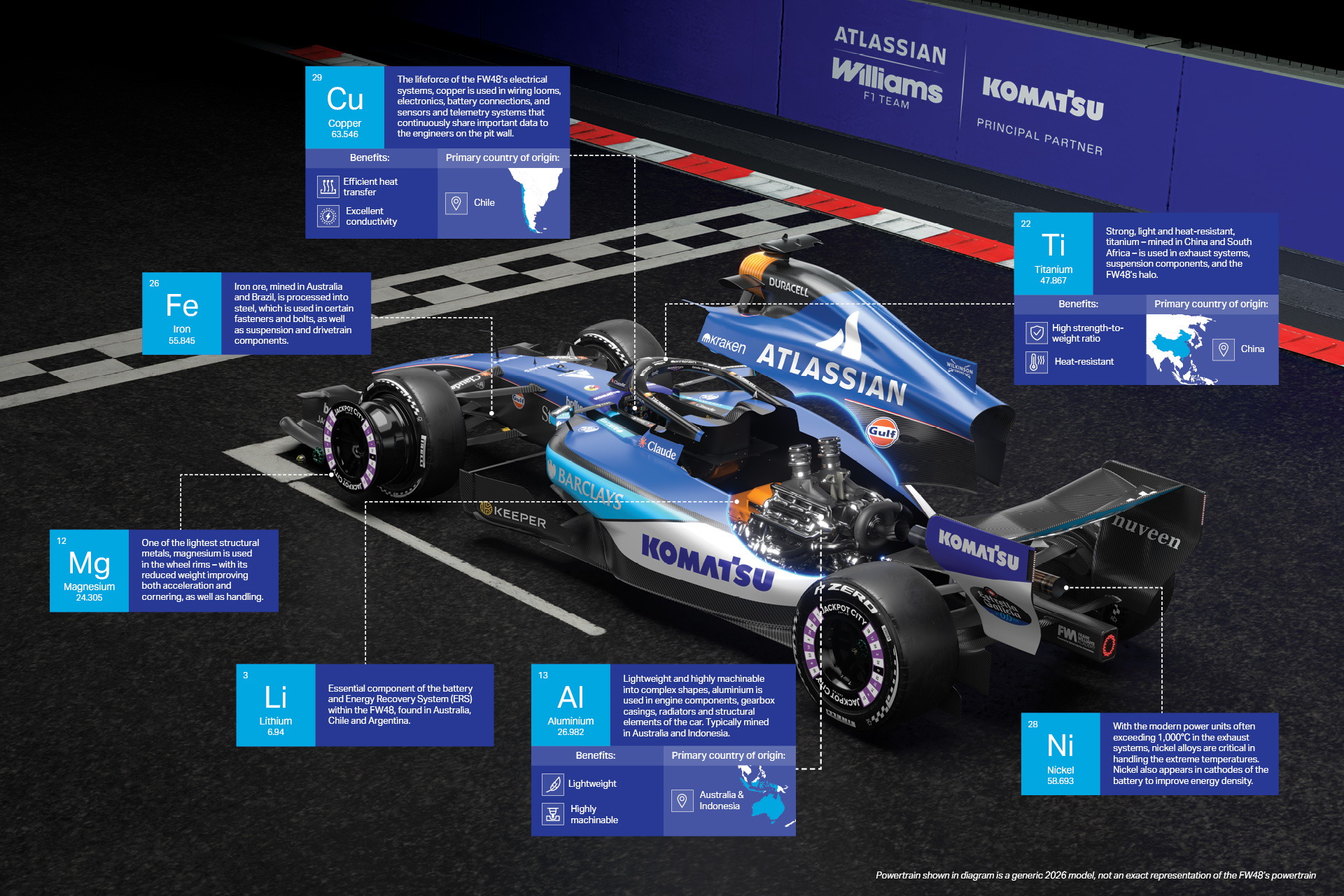
Ever wondered what a race car is actually made of? Discover how Komatsu’s mining machines help build Atlassian Williams F1 Team’s FW48.