.svg)

.svg)






3 min read
Oct 5, 2026
Komatsu’s Newberry facility celebrates 25 years of manufacturing, teamwork and continuous improvement
- Press release,Construction,Company
10 min read

At Komatsu’s global mining headquarters, two Komatsu Williams Engineering Academy students discovered how an array of engineering disciplines, ideas and people come together to advance mining technology and how future engineers can help push the boundaries of what is possible.
In two weeks, Aran Malhotra would be heading to college to begin pursuing the future he had already pictured for himself: Becoming a mechanical engineer.
Sen de Montigny was still exploring. She knew she was drawn to engineering, but she was not ready to define her future by one discipline or one job title.
Then they walked through the doors of Komatsu’s South Harbor campus in Milwaukee, Wisconsin, U.S., the global mining headquarters of the company.
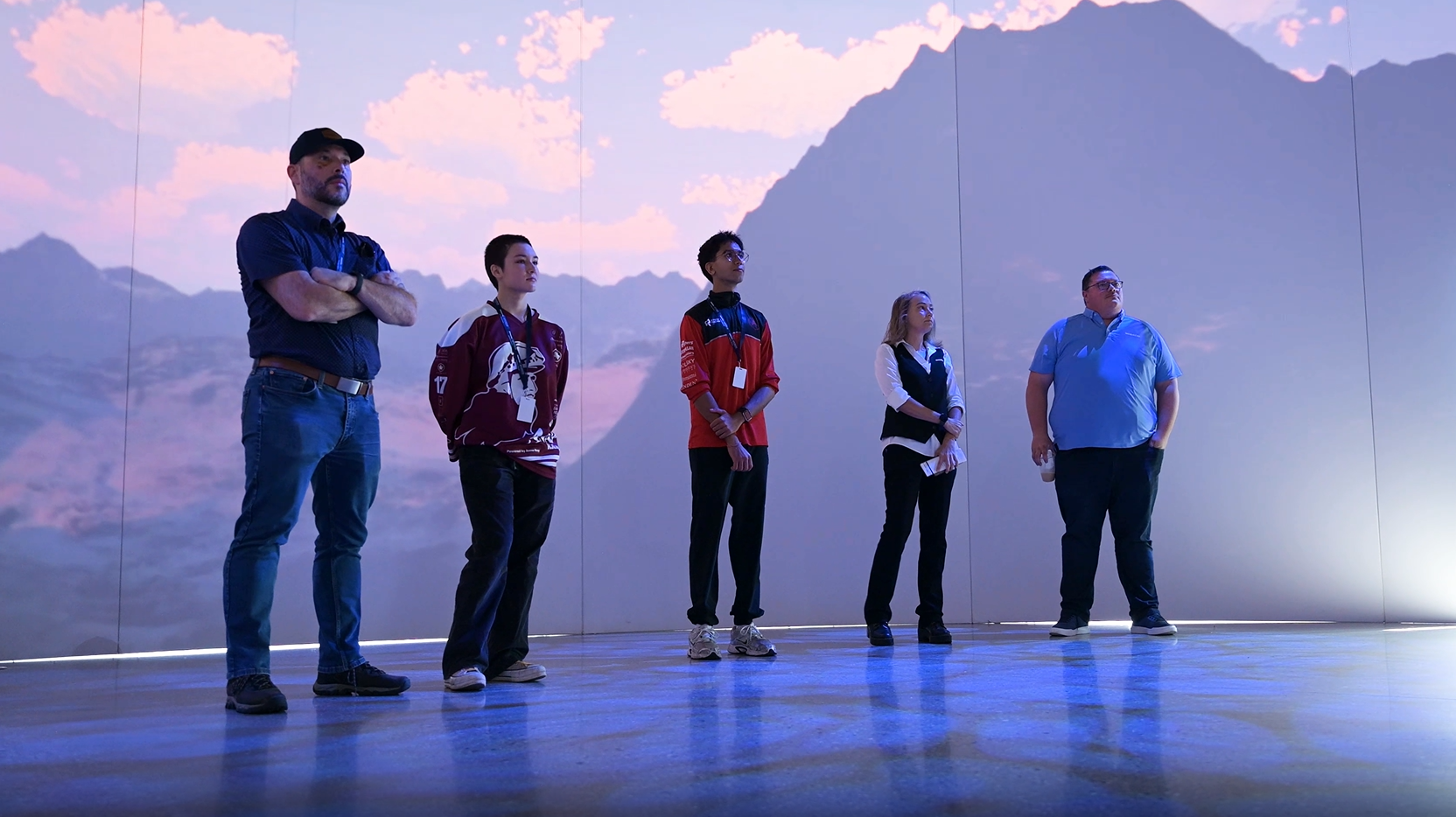
Malhorta and de Montigny are both part of the Komatsu Williams Engineering Academy, a partnership between Komatsu and Atlassian Williams F1 Team that aims to create pathways to careers in science, technology, engineering and math (STEM) fields, particularly within the engineering industries.
At South Harbor, the two Komatsu Williams Engineering Academy students stepped into virtual designs, operated scale-model mining equipment, toured the manufacturing facility and spoke directly with personnel working across a number of fields: mechanical, electrical, software, automation, controls and structural engineering disciplines.
But what stayed with them was not simply the technology. It was the access.
Wes Taylor, Senior Manager Autonomous Vehicle Platform, helped shape the day and connect the students with engineers across the facility. More than describing their work, the engineers invited the students into it, guiding them through demonstrations, answering questions and showing how different disciplines contribute to the development of mining equipment and technology.
Lead Engineer II Chuck Payne walked the students through the Electrical Lab to show how Komatsu engineers test and validate the electrical systems and components that help machines operate safely and reliably. While each engineering discipline has expertise, the value is realized through collaboration.

Malhotra and de Monigny saw how different technical disciplines depend on one another, from the earliest design decisions through testing, manufacturing, transportation, operation and service.
Mechanical engineers may work in structural analysis, component design or automation. Electrical and software engineers may contribute to controls, system integration, testing or hardware simulation. Manufacturing specialists then help turn digital decisions into physical components that can be machined, assembled and delivered safely.
Taylor, who began his own Komatsu career as an intern working on sensors and control systems for electric rope shovels, helped the students understand that a degree or job title is only the beginning.
“A title means one thing, but what you learn and how you focus your skills throughout your career is what ends up defining it,” Taylor said.
Senior Engineering Manager James Hutsick gave the students a broad view of engineering at Komatsu. Drawing on 26 years of experience connected to electric rope shovels, he explained how different groups contribute, from early design through testing, manufacturing and support.
“Large mining equipment is never the work of one discipline,” Hutsick said. “The best solutions come from understanding how every decision affects the machine as a whole.”
The students learned that engineering decisions cannot be separated from the environment where equipment will work.
Senior Manager of Mining Application Engineering Chase Maxey’s work has taken him to mines around the world, where differences in geography, operating practices and customer needs influence equipment and technology. He guided students through connecting the work of the machines to how mines are designed and planned.
“To understand the equipment, you also have to understand the mine,” Maxey said. “The way a site is planned and operated shapes the technology customers need.”
Jason Zidek, Senior Engineering Manager for all surface drill products and technology, shared a product-focused view of engineering. His work spans across hardware, software, development and technical support behind surface mining drills.
He explained, “Every design decision has to support how the machine will perform in the field. The product may begin as an engineering concept, but it ultimately has to work reliably in a demanding operation.”
Together, the engineers’ perspectives helped the students see how engineering can serve as a response to real operating challenges.
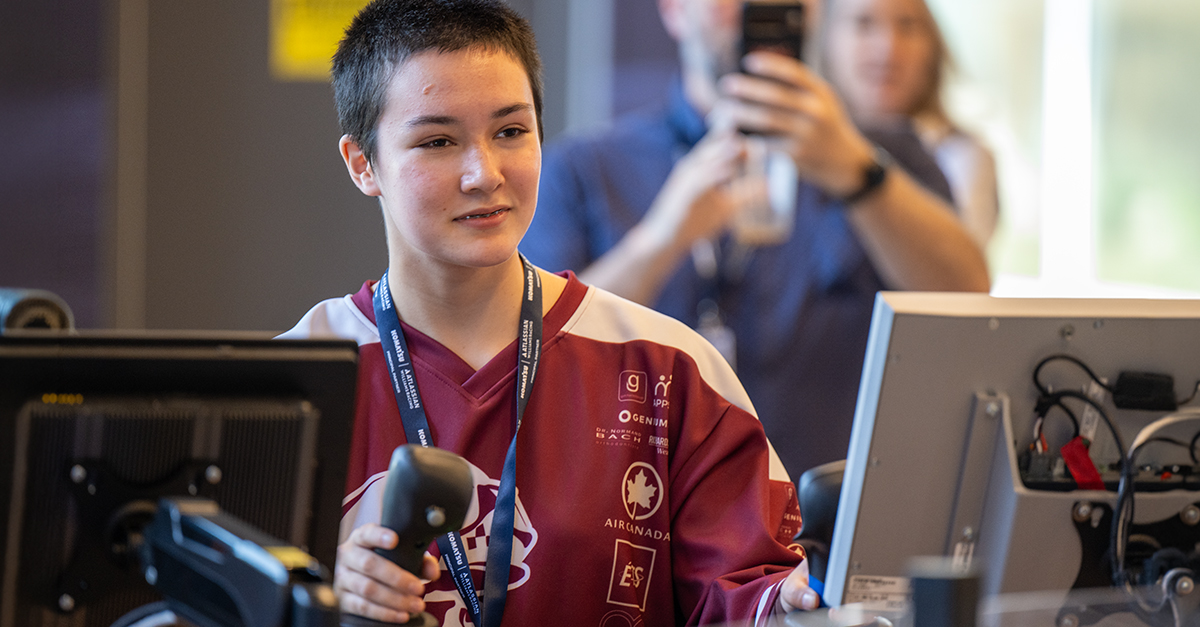
In the Automation Lab, the scale of mining created an immediate question: How do engineers test technology for equipment that is too large and costly to pull out of production or rebuild every time they want to learn something new?
One answer was moving across the lab floor.
Engineers use one-twelfth-scale machines to test software and automated functions in a controlled environment. The models allow teams to explore technologies related to full-sized equipment more frequently, including collision-avoidance systems and lidar, which uses laser pulses to map the surrounding environment.
The demonstration expanded the understanding of testing. It is not simply a final step before a product is released. It is a continuous process of asking questions, gathering information and improving designs.
That willingness to keep learning is increasingly important as technology changes. Mining has used autonomous haulage commercially for years, and engineers continue to advance automation, remote operation, sensing and software across the industry. The work requires not only technical knowledge, but creativity, collaboration and the confidence to explore ideas that have not been fully solved yet.
“What surprised me most was the sheer size of everything,” de Montigny said. “To see the scale at which engineering can operate … and the way in which engineers test all of these systems and equipment.”
Virtual reality can help engineering teams examine access, assembly, maintenance and component movement before a physical design is manufactured. For Malhotra, entering a digital model made one principle clear: A design must work not only for its creator, but also for the people who will build, operate and maintain it.

When Malhotra put on a virtual reality headset, he could move around a digital model of part of an electric rope shovel and examine it from different angles and interact with different parts.
Josh Vizanko, Senior Technical Specialist, explained that virtual reality can support reviews of access, ergonomics, assembly, maintenance and the way parts fit or move together, in ways that are difficult in traditional design software.
The experience made an important design principle visible. Engineers must consider more than whether a component can be modeled in its place. He explained, “Virtual reality lets us experience a design before it physically exists. That helps us identify questions earlier and consider the people who will build, operate and maintain the equipment.”
That lesson continued on the manufacturing floor.
Malhotra and de Montigny saw machining, heavy fabrication, gearing, quality inspection, welding and assembly in action. The processes showed how digital decisions become physical components and how scale must be managed with precision. Some machining processes may remove thousands of pounds of steel from one component while the finished part may still require tolerances measured in thousandths of an inch.
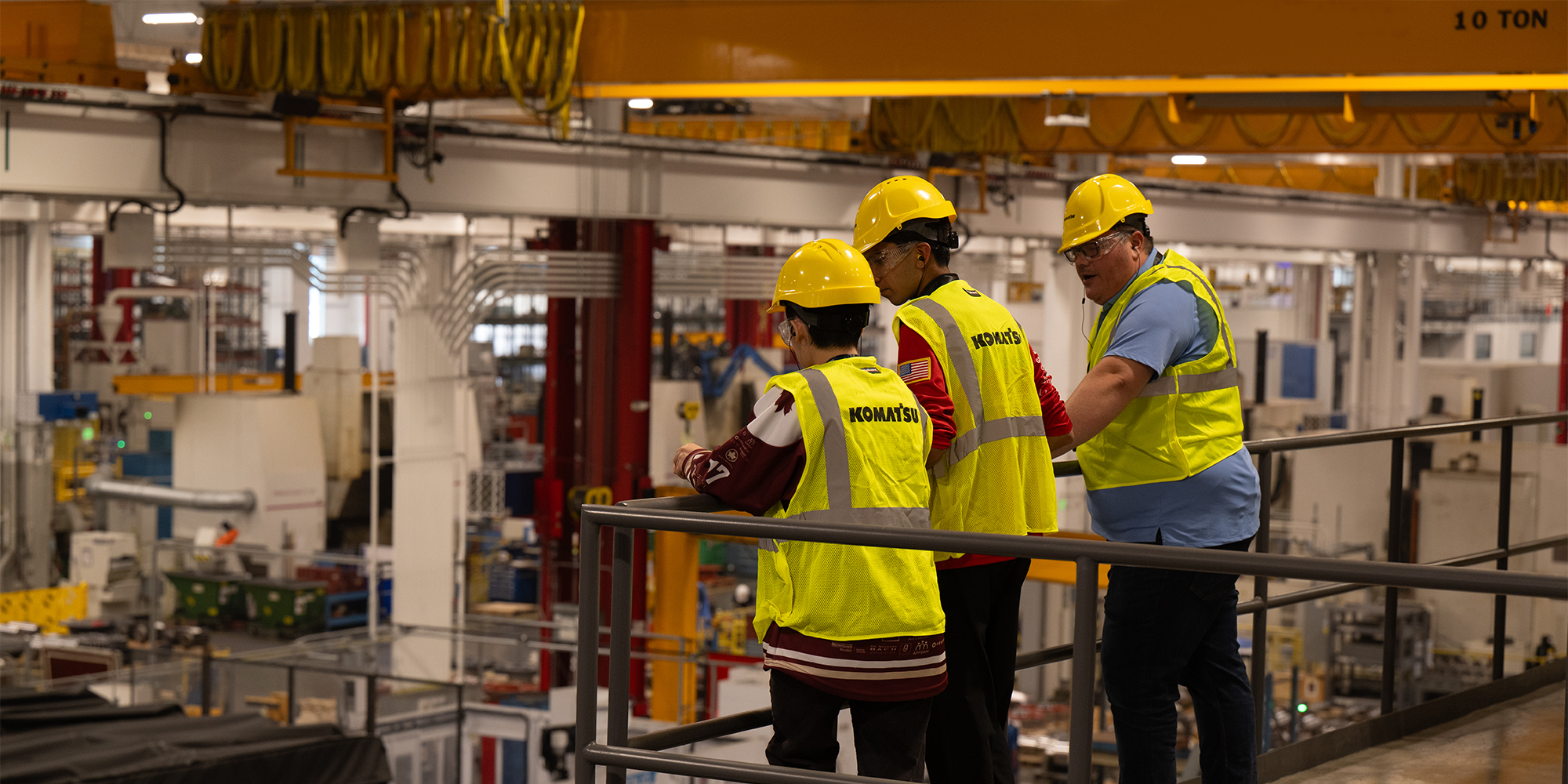
For the Komatsu employees involved, the visit was not an unusual assignment. Many have worked with students repeatedly because they understand what an early conversation, demonstration or invitation can change.
Payne coaches local youth robotics teams and has long shared the value of teamwork, leadership and collaboration to be successful. “When students build something themselves, they begin to see that engineering is not only about getting the right answer. It is also about testing, adapting and working together,” he said.
They also know the industry will need the next generation’s ideas. Technology is evolving quickly, and the challenges ahead will require bright, creative people who are willing to work across disciplines.
Automation Engineer V Megan Scheppa said student visits can make careers that are not always visible easier to imagine. “We get to teach them what we’re doing here and show them automation as a career possibility,” she said. “I hope they leave feeling excited by what is possible and that they could be the ones who help shape what comes next.”
“I really enjoyed learning about different levels of autonomy, how they’re applied to the different machines and how Komatsu deploys that autonomy,” Malhotra said, “… how they’re always evolving and innovating based on customer needs.”
Employees also had an opportunity to share their passion for an industry that many people rarely see or fully understand.
Mining machines are immense. The technology inside them is advanced. And the work they support reaches into nearly every part of daily life. Infrastructure, transportation, electronics, energy systems, health care technologies and countless everyday products depend on materials that begin with resource extraction.
As Scheppa said, “We like to remind people, if it’s not grown, it’s mined.”
As Malhotra tried the controls of a scale-model shovel, Scheppa shared the thinking behind the technology, the questions engineers continue to explore and the possibilities still waiting to be developed.

Through the Komatsu Williams Engineering Academy, Malhotra and de Montigny have experienced two engineering environments that may appear very different: The world of Atlassian Williams F1 Team and mining.
One focuses on an elite race car designed for speed and performance. The other includes machines developed to move large volumes of material in demanding conditions.
Both rely on precise analysis, repeated testing, specialized knowledge, advanced technology and close collaboration.
Malhotra said being part of the Komatsu Williams Engineering Academy has been an incredible opportunity learning more about engineering within the different industries. One of the biggest takeaways, he said, was “just how similar the advanced technology in this sector of the industry, construction and mining, [is] to motorsport and high-performance racing.
“Being able to learn from intelligent people on both sides of the industries … is an excellent platform for someone that loves engineering.”
The academy uses those shared principles to help students see how widely engineering skills can apply. The purpose is not to direct every student toward the same discipline or industry. It is to expand the range of futures they can imagine.
“For me, what the academy has allowed me to do is get inspired by all the amazing people,” de Montigny said. “They’re among the best of the best in their fields and the experience has also shown me the different opportunities and career paths I could pursue within engineering.”
At lunch, engineering interns Ari Scheuer, Corwyn Hurda and Maks Klincewicz gave de Montigny and Malhotra another valuable perspective: What it feels like to be at the beginning of an engineering career.
They discussed their internships, capstone projects and the transition from studying engineering to contributing within a working team. Hearing from interns starting their career alongside experienced engineers, some of which started as interns, themselves, it helped connect the first stages of a career with where that path could eventually lead.
The visit gave de Montigny and Malhotra a broader understanding of what engineering at Komatsu can involve: Learning from people with different expertise, adapting as technology changes and contributing to work that extends beyond any one discipline.
More importantly, it gave them the opportunity to meet the people behind that work. By sharing their experiences, Komatsu engineers helped make the technology, and the career possibilities connected to it, more visible.
Komatsu’s South Harbor campus in Milwaukee brings engineering, testing and manufacturing into one location. Teams there support work involving mining shovels, large gearing, heavy fabrication and surface drill engineering and test manufacturing.
Discover how the campus was designed to support advanced manufacturing, sustainability and Milwaukee’s long history of mining innovation, including its LEED Gold-certification, renewable energy features, water conservation systems and connection to the surrounding community.
Explore a campus designed for what comes next.
Interested in solving practical problems through engineering, software, automation or manufacturing? Explore career paths and student opportunities that can help you see how your interests may apply in the working world.
Push the boundaries of what’s possible: https://globalcareers.komatsu/